LME 590 Practicum Week 11

Hello Everyone,

As a way to reflect on my entire two months and a day of Practicum experiences and to satisfy a LME 590 Portfolio requirement, I have created a digital storytelling presentation using Windows Movie Maker and Audacity. The video highlights various activities in which I have engaged during my time at my elementary school library media center placement and includes footage of my teaching a fifth grade lesson on genre. On YouTube, the video is available at https://www.youtube.com/watch?v=ZxKCrkjSyNM.

Enthusiastically,

Ms. Tyler

LME 590 Practicum Week 10

Hello Everyone,

Since I have finished accumulating and documenting my 120 Practicum hours, having a total of 135 hours, I have chosen to make my last LME 590 Journal entry a reflection on the following CEBS Dispositions.

Values collaboration. Actively seeks out and incorporates ideas of others. Takes leadership in working with others to improve the overall environment. Regularly share information and ideas.

One way through which I have become able to seek out the ideas of others and regularly share information and ideas has been through membership in the Kentucky Library Media Specialists Listserv. The KYLMS Listserv acts like a giant contact list, through which I can connect with library media specialists in different levels of public and private schools across the state, as well as library media education students and district-level administrators. My growing involvement started with the search of what to do with discarded non-fiction books since I was becoming responsible for weeding the non-fiction collection of my Placement library media center. The Kentucky Department of Education Library Media/Textbook Consultant encouraged me to reach out to the KYLMS Listserv, since she did not have such a list, so I subscribed to the Listserv and sent my first post on January 19. I was surprised at the rapid and voluminous response my post received. Library media specialists from elementary, middle, and high schools in both public and parochial settings from across the state contributed suggestions and ideas to help with this project, including the 2014-2015 President of AASL. Mostly, they voiced five options for the old non-fiction books: throw them away, recycle them, sell them, give them to teachers and students, donate them, or repurpose them through art projects. I thanked each respondent personally with an appropriate comment about the advice he or she had offered. Overall, thirty-one emails were exchanged over this topic of weeding non-fiction books.

In addition to receiving advice about the weeding of the non-fiction section, I also contribute to the sharing of knowledge as I am able, by providing lesson resources and help with facilitating access to information resources. For example, I offered one library media specialist looking for a genre assessment a modified version of the “Genre Bingo” activity I am implementing as a reading promotion activity at my Practicum placement for students in third through fifth grade. After creating a video to guide viewers through using the WWWDOT criteria to evaluation two different websites, I sent the link out to my YouTube video to the Listserv members, making the video available at https://www.youtube.com/watch?v=GEk2mm_4UOU. One middle school library media specialist responded that she would love to look at the video, yet the link was not working for her. I made another version of the link using TinyURL, and she was able to access the video. I also replied to the request of the librarian at the Kentucky School for the Deaf asking for a genre presentation by giving her a PowerPoint presentation I made explaining “genre” and the basic characteristics of nine genres and a link to a video I created using the PowerPoint presentation to use in a lesson with fifth grade students at my Practicum placement. To further facilitating access to information resources, I also posted a modified version of the help sheet I created for searching a Destiny library OPAC using either Accelerated Reader score ranges or Lexile levels for the library media specialists to use with or give to their patrons. It was a pleasant surprise to have a LME classmate respond to that post, as well as two library media specialists.

Values professionalism: Respect for school rules, policies, and norms. Knows school rules and policies. Follows them consistently. Understands the purpose of regulations and respects their intent. Accepts responsibility for personally following them in patterns of dress, behavior, etc. EPSB Code of Ethics.

My understanding of the purpose of and respect for school rules, policies, and norms is evident through my consistent following of the rules, policies, and norms, especially modeling appropriate behavior and monitoring student behavior during security and severe weather drills. One Friday morning, the school engaged in both a lock-down drill and a tornado drill, minutes apart from each other. I helped enforce the expectations of the drills and modeled appropriate behavior by moving quickly to designated areas for each drill and ensuring silence among students. Every day at Practicum my professionalism is demonstrated through my responsibility to adhere to a professional dress code, with the slight exception of the hat, gloves, bow tie, furry tummy, and tail I added to an appropriate black turtleneck shirt and black dress pants when I was attired as the Cat in the Hat on “Read Across America Day.” Even my dressing as the Cat on that day was in accordance with the school norm of dressing as a storybook character in observance of what would have been Dr. Seuss’ birthday.

Values professionalism: Commitment to self-reflection and growth. Recognizes personal limitations and strengths and uses them to best professional advantage. Actively seeks suggestions and constructive criticism. Regularly practices critical thinking. Regularly engages in learning through self-reflection.

My personal choice to read 7 Keys to Comprehension by Susan Zimmerman and Chryse Hutchins and use as a launching pad for collaboration with the classroom teachers at my Practicum placement is a demonstration of this CEBS Disposition. I recognized my personal limitations in understanding the details of reading comprehension and used it to the best professional advantage by asking the classroom teachers which resources, if any, I could offer them about reading comprehension. When the results of the survey showed picture book lists would be helpful, I was armed with knowledge about the different strategies from 7 Keys to be able to effectively compile appropriate lists and cross-reference them.

Enthusiastically,

Ms. Tyler

LME 590 Practicum Week 9: Part 2

Hello Everyone,

It was bittersweet for my last day of Practicum to be the school–wide celebration of “Read Across America Day” on March 2nd. I was finally able to reveal the correct answers to my bulletin board display, which was exciting since the library media specialist said a couple of the students had told her they knew who the “twins” where, which I took to mean they knew the silhouettes of Thing 1 and Thing 2.

seuss2

To make it possible for each Special Area teacher to celebrate what would have been Dr. Seuss’s birthday with all the students in the school, each Special Area teacher had an activity station in the school gym through which students rotated in grade-level groups. At the library station, each student received a paperback book and colored a Dr. Seuss bookmark. At the P. E. station, students participated in a Green Eggs and Ham relay obstacle course.  At the science station, students participated in a One Fish, Two Fish, Red Fish, Blue Fish chemical reactions activity. At the Art/Music station, students practiced singing of the “Green Eggs and Ham” song from Seussical the Musical. This particular “No Color Day,” where every class goes to the gym at their grade-level’s Special Area time, was at the request of the library media specialist, so each student could celebrate Dr. Seuss’ birthday on the actual day, rather than her celebrating “Read Across America Day” with only the Wednesday group of students and having to carry over the activities deeper into March and April, when it would no longer be relevant. After assisting with the library station for a few classes, I became responsible for the science station. It was also determined that the school would encourage faculty, staff, and students to dress as their favorite storybook characters, so I spent the day dressed as the Cat in the Hat.

cat

A reporter from the local newspaper visited the school that day, and I spoke briefly with him about “Read Across America Day” being a way to honor the life and work of Dr. Seuss, highlighting that the school was celebrating by dressing as book characters and that the library media center, specifically, was giving away free books of various types and topics by different authors and Seuss-related bookmarks to the students, so each child would have his or her own book. Almost two weeks later, my photograph made it into the slideshow posted on the newspaper’s website, showing how different schools across the district were celebrating “Read Across America Week!” It was fantastic to get to represent “my” library in the media.

cat2

Enthusiastically,

Ms. Tyler

LME 590 Practicum Week 9: Part 1

Hello Everyone,

I have learned so much from weeding the nonfiction collection and starting to weed the Everybody collection. Since the current library media specialist started working in the library media center after the collections had been moved from the old school building to the new, she did not have an opportunity to weed the collection while it was being and moved. I believe it would have been a beneficial thing for the previous library media specialist to have done when the materials were being boxed up and transferred, especially since I have removed over 600 books From the current collection in about two months. The weeding process can be done more efficiently when engaged in a monthly or at least a semester or school year basis. A library media specialist did mention that some of her extended days this school year would be to continue where I left off on the weeding. It would also be helpful to target specific areas within the main divisions of the collection when weeding, such as one Dewey decimal classification or one author last name section, so the task does not seem too daunting and unmanageable. When readying the books we could donate to organizations, the most time-consuming was removing the ownership Stamps from within the books. Although I know best practices state “ownership marks should be stamped on” each book’s “page after the title page, along the edges, and on a secret page” (Morris, 2010, p. 431), I am beginning to question this practice because of the time it takes to add the ownership marks before a book can go on the shelves and to remove those same marks before it can be sold, recycled, or donated. It was interesting to find that books purchased by the previous library media specialist had ownership marks on the front cover, back cover, title page, and either page 9 or page 25 of the text. The current library media specialist is not strictly enforce the use of ownership marks and states she is unsure if she has a school library stamp, since office supplies It routinely “walks away” from the library media center due to it being used for faculty meetings and other after-school events.

wk91

I have also learned a great deal from my cataloging of various items. I worked with recent donations, which needed to be added to the OPAC, items needing their call tag stickers changed so they were in places that were more logical for students, and items that were additional copies of currently held titles. For each item, I created and printed bar code labels and call tag stickers and, as needed, included AR Level range and series stickers on the spines. Personally, I think the AR stickers would be better placed on the inside cover of the book rather than the spine, since best practices state “labeling book spines with ‘book levels’ threatens students’ privacy” (Adams, 2013, p. 42). This new labeling placement system would also perhaps help some students move away from focusing on AR levels as their primary selection criteria and focusing more on the topics, series, or authors they will enjoy reading. This new placement of AR stickers would also eliminate the need for using tape to cover the stickers on the spines, which would lessen purchasing expenses for library-related office supplies.

wk92

Enthusiastically,

Ms. Tyler

References

Adams, H. R. (2013). Protecting intellectual freedom and privacy in your school library. Santa Barbara, CA: Libraries Unlimited.

Morris, B. J. (2010). Administering the school library media center. (5th ed.). Santa Barbara, CA: Libraries Unlimited.

LME 590 Practicum Week 8

Hello Everyone,

Zimmermann and Hutchins’ (2003) 7 Keys to Comprehension finally explained to me the seven vital facets of reading comprehension seemingly taken for granted as understood in my undergraduate Language Arts Methods course. Although written primarily for parents, this book helped me as an educator understand concretely the reading comprehension strategies I engage in subliminally so I can now more confidently teach them and helped me realize “real comprehension has to do with thinking, learning, and expanding a reader’s knowledge and horizons” (Zimmermann & Hutchins, p. 7) rather than just decoding. From their explanations, I was able to see that creating mental images is synonymous with visualization, while background knowledge is synonymous with schema. I feel this book greatly helped my ability to produce the inferring, visualizing, and questioning book lists for the teachers at my Practicum placement of varied and high-quality picture books they could use to model these three strategies or ask students to practice using these three. My deeper understanding of reading comprehension strategies also helped me cross-reference the lists by helping me see that the same book can be used multiple times to focus on different strategies since they are all interconnected in the mind of the reader and are often utilized simultaneously.

I was again responsible for Open Check-Out on Friday afternoon, during which a total of only 78 books were checked out by students. This total being the lowest of my Fridays is due to the school-wide celebration of Jump rope for Heart during Special Area times, so all classes of students participated in activities in the gym, and books did not circulate as much as in the morning. As students needed assistance, I conducted readers’ advisory sessions. When students were not in the center, I finished weeding the “B” section of the Everybody books and continued removing the weeded “A” section books from the OPAC.

Enthusiastically,

Ms. Tyler

Reference

Zimmermann, S. & Hutchins, C. (2003). 7 keys to comprehension: How to help your kids read it and get it! New York, NY: Three Rivers Press.

LME 590 Practicum Week 7: Part 2

Hello Everyone,

This week, I taught my genre lesson to a class of fifth grade students. Overall, it went well. The students were attentive during the direct instruction portion, some even asking relevant questions like “What about graphic novels?” and “Is Dr. Seuss poetry?” which I was able to address efficiently. They enjoyed working with the mini iPads to scan the QR codes during the investigation of the library media center. Before the lesson, the library media specialist mentioned that some of the students in this class had difficulty with reading comprehension and writing, perhaps needing a scribe to help them with their schoolwork. Since I had not considered those possibilities, I was glad I had already planned for the students to work in groups of three or four during the investigation, which demanded both reading and writing.

During the investigation, I noticed a group having an animated conversation, so I went over to listen and see if I could be of assistance. One student was trying to convince his classmate that “Oklahoma” was not a clue to why Out of the Dust belonged in the historical fiction genre. He said anyone could say they lived in Oklahoma, including himself, and was adamant “the 1930s” was the clue because it was in the past. After the classmate finally agreed with him, I stepped in and reaffirmed their thinking that “the 1930s” was indeed a more appropriate clue. Below is the Dust poster and the text from the QR code being scanned.

genre1Below are photographs of student groups working on the investigation.

genre2

Later, during the whole-group sharing, I alluded to the Dust conversation without mentioning the actual group of students to address the possible misconception other students might have had. It was a surprise to them that My Librarian is a Camel belongs in the informational genre, since, to some, it sounded like a fiction title. When students had difficulty giving the genre and clues of a title, since not every group was able to complete the entire investigation, I used the “phone a friend” technique I started employing as a substitute teacher (a student needing help can call on a friend whose hand is raised and ask him or her the question I asked, listening for the answer. Over time, I have realized it gets the first student “off the hook” if I merely accept the answer of the second student and move on so the first student has to repeat to me what his or her friend said, which makes the first student accountable for listening to the correct answer and restating it.) I let one particular student “phone a friend,” and the library media specialist later said the technique was great for her, since she is a non-reader and can sometimes be defiant when unable to answer a question. By “phoning a friend,” the student was able to get the answer to the question I had posed to her and “save face” in front of the class, since “phone a friend” was used by a few other students during the share time.

There are a few things I would change when teaching this lesson again to a group of students. I would include a “Share Time” slide on the PowerPoint presentation that would give me the book cover and possibly group number to keep my facilitation of the investigation results on pace. I know I stopped calling on groups at group seven and did not have representatives from groups eight or nine give the genres of the last two books because we were running out of time and I lost my place in the group numbering. This slide would also contain the genre of each book that would pop up on the screen after a student had given the genre to aid in students being able to add to or change their booklets if needed. By having the book cover and genre on the screen after they are discussed, I would be able to assist those students who would benefit from written text accompanying the oral discussion. I would have all students write down the group numbers I gave them on their investigation booklets. Once several groups began working on the investigation, some students forgot the numbers I had given them. I would also have provided a quick reminder about using the QR code scanner on the mini iPad to the whole group before starting the investigation, rather than briefing each group individually.

Enthusiastically,

Ms. Tyler

LME 590 Practicum Week 7: Part 4

Hello Everyone,

Friday, February 19, 2016, I had more time without students in the library media center than with students the center. Although I did conduct a few readers’ advisory sessions, I mainly worked on putting up the bulletin board on Dr. Seuss. My title was “Guess who is wishing Dr. Seuss a Happy Birthday?” which helps students know they are expected to guess the character silhouettes. I also included a photograph of Theodore Geisel to help students recognize the author with his real name and birth-date to aid students in understanding that “Dr. Seuss” is a pseudonym. To get the bulletin board up, I had to die-cut all of the letters for the question title and the check-out invitation, as well as die-cutting and laminating the number plates to show the correct answers on “Read Across America Day.” Currently the bulletin board has the character names and book covers scattered across the board, not close to the character silhouettes. This was at the suggestion of the library media specialist so students would know what books the characters were from, as a sort of scaffolding to their enjoyment of guessing the characters. On March 2nd, I will turn over the black silhouettes to reveal the colored characters and move the book covers with the character names next to the correct number plates.

seuss1

Enthusiastically,

Ms. Tyler

LME 590 Practicum Week 7: Part 3

Hello Everyone,

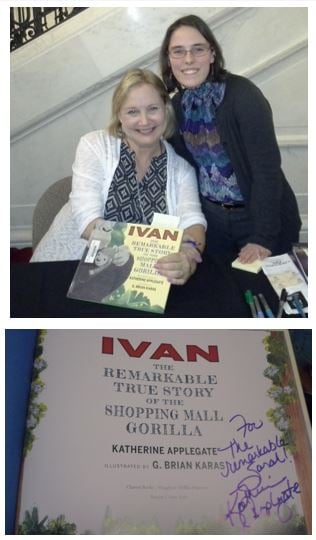
I was extremely excited to hear and meet author Katherine Applegate at the Main branch of my city’s Free Public Library on February 17, 2016. Her talk was mostly geared towards the children in attendance and gave information about the writing of The One and Only Ivan, the 2013 winner of the Newberry award, and her latest book Crenshaw. She discussed how being a writer is a wonderful yet weird job, that she is paid to be a “slob” and a “liar,” which garnered laughter from the adult members of the audience. To the children, she said you can write about anything if you only use the two words “what” and “if,” so there is now no excuse when a teacher says to write about something. Sometimes you write a couple of pages, and there is only one gem that will stay in the story, so you shouldn’t be afraid to make mistakes. It’s really the best part of writing, because then you’re learning. She confessed she did not enjoy reading as a child and was not interested in books or writing until she was older and finally found some “book best friends” like Charlotte’s Web. To those in the audience secretly wanting to write children’s books, she suggested we join a chapter of the Society for Children’s Book Writers and Illustrators to network with other writers and find potential editors and publishers. (There is a regional chapter in Indiana but not in my state.) I believe her talk was recording and hope it will be available on the library’s website.

After her presentation and a Q&A session, she held a signing session. I went with my personal copies of The One and Only Ivan, and Ivan: The Remarkable True Story of a Shopping Mall Gorilla and my placement library media center’s copy of Ivan: The Remarkable True Story. Considering I had already decided I would have the library copy signed if it was one copy per person, I was thrilled she was able to sign all three for me and agreed to having our picture taken with one of the picture books! When I mentioned my kids would be ecstatic to know I had met her, she asked if I was a teacher, to which I replied that I was studying to be a librarian. She said “librarians are the best” and wished me well as I finish my master’s degree.

applegate

Enthusiastically,

Ms. Tyler

LME 590 Practicum Week 7: Part 1

Hello Everyone,

CEBS Disposition: Values diversity – Willingly works with others from different ability, race, gender, or ethnic groups. Welcomes feedback and interaction with others. Listens carefully to others and respects the views of those perceived as different from self.

I demonstrate my willingness to work with, listen carefully to, and respect the views of others through the individual reader’s advisory sessions I conduct with students from kindergarten through fifth grade. Since I am always welcoming to students and proactively offer assistance, the students are starting to seek me out in the library media center to help them find specific things or help them find a good next read. For instance, I was asked by a fifth grade student if I could help him find a book because “I was really good at that.” After talking with him for a while, we decided he should try Civil War books, since he enjoys history and geography and is ready to move away from books about things like the Grand Canyon; he found a Civil War book in his AR range to check out and thanked me for my help. Some students seem to thrive on books about ghosts or the Captain Underpants series, and I routinely help them find books on that topic or in that series, even though their views of desirable subject matter can be perceived as different than my personal reading preferences.

The students with which I conduct readers’ advisory encompass a wide range of abilities, are both male and female, and sometimes, members of a different ethnic group. For example, there is fourth grade student who only speaks Spanish and has almost exhausted the collection of bilingual books we currently have in the library media center, although some titles are coming in non-fiction order. Every time he comes with one of his classmates who is bilingual, I try to find different books for him so he does not have to keep reading the same few books repeatedly. While going through the OOPS mini-shelf of books in the library media center (these books are for students to use while their classmates are checking out new books if they forgot to bring their books back), I found four bilingual fairy/folktales. Once the library media specialist showed me how to add titles to the OPAC, I added these four books first to give the Spanish-speaking student a broader variety when he next visits the library media center.

As a way to welcome feedback and interaction with students, I enjoy hearing about what a student thinks about a book I recommended to him or her or one I helped them find. There is a fifth grade girl who always wants recommendations about what to read next. Once, I was helping her browse and she came across Lisa Graff’s A Tangle of Knots and liked the cover. I suggested she try it since the cover was interesting to her for at least twenty pages (my personal rule of thumb for trying books); the next time I saw her, she said she really liked A Tangle of Knots and thought I might as well. Another time, I talked to a third grade girl about the “Whatever After” series by Sarah Mlynowski, and we wondered how many more books there were in the series. We discovered the school library media center owned the fifth book in the series, I used Google to find that the series currently contains eight books, so I went to the OPAC of the local public library to see where the student could check out the latest four books. She was ecstatic at the news that there are four more books in her favorite series that she could check out from the public library when her mom took her again. The student already had the title of the series written in her planner, and I offered to write down the author’s name, the numbers of the next books she would want, and the name of the public library that had all of them currently available. I also mentioned to her that it is possible through some public libraries to check out eBooks on her tablet at home. She said I was the “best librarian ever,” and she could not have done all of this without me, thanking me for all my help.

Enthusiastically,

Ms. Tyler

LME 590 Practicum Week 6

Hello Everyone,

Due to snow, my teaching a two-day unit on genre with fifth grade students has been rescheduled to a one-day lesson next week, so I have reworked my lesson plans and student handouts to reflect the condensed scheduling. It has been somewhat difficult to condense the lessons, yet I have striven to focus on the activities that are the most beneficial and interesting for the students. The activities still follow the “gradual release of responsibility” (AASL, 2009, p. 8) I had originally planned while continuing to necessitate student group work and the scanning of QR codes using mini iPads to discover the genres of the book examples I have pre-selected. Working in groups, students will complete portions of my original investigation sheets, yet the sheets have been modified into a booklet on which they will record the QR scavenger hunt and a definitions sheet on which they will record their definitions of the genres.

On Friday, February 12, 2016, I independently managed the circulation desk. During the afternoon, a total of 100 books were checked out by students. This number is much lower than last week, most likely due to Valentine’s parties in the classrooms in the afternoon and a school-wide assembly to introduce the year’s Jump Rope for Heart campaign.

When students were not in the library media center, I worked on the library media center’s bulletin board in the hall next to one of the two entrances by removing the current display and cutting out the Dr. Seuss photographs I found for my “Dr. Seuss” display which asks students to name the character silhouettes. I had planned to finish cataloging the thirty-three recently donated books I started working with last Friday by attaching the bar codes, spine labels, and any Accelerated Reader score level stickers. However, when I arrived, I found that the fifth grade student worker had completed those tasks already. There is currently a student who comes to help in the library media center on Fridays for an hour or two; he had wanted to be a part of the morning broadcast team again, yet the library media specialist remembered other students making fun of this boy because of a slight difference in his speech. She did not deem it a good fit for him to be on the morning broadcast team this term and instead offered he work in the library. The boy really enjoys his time and says he wants to be a librarian when he is older. I was glad I had added to the titles to the OPAC and printed off the bar codes and spine labels, so the student could then attach the bar codes and spine labels and look up the AR sticker colors. It is wonderful that the library media specialist has given the students the opportunity to assist her in the library media center, since he seems to desire “special-ness,” similar to what would have been available to him as part of the morning broadcast team.

To prepare for introducing my “Genre Bingo” activity to third through fifth grade students, I made a video to use during their library class times available on YouTube at:

https://www.youtube.com/watch?v=ct5cpzNFf4U

Enthusiastically,

Ms. Tyler

Reference

 American Association of School Libraries [AASL]. (2009). Standards for the 21st-century learner in action. Chicago, IL: American Library Association.